Indiana paused some disability-waiver eligibility decisions after higher denial rates
Indiana FSSA says eligibility rules did not change when it adopted interRAI assessments in 2026, but denials increased and the agency later paused certain determinations for review. Key outcome counts remain unavailable.

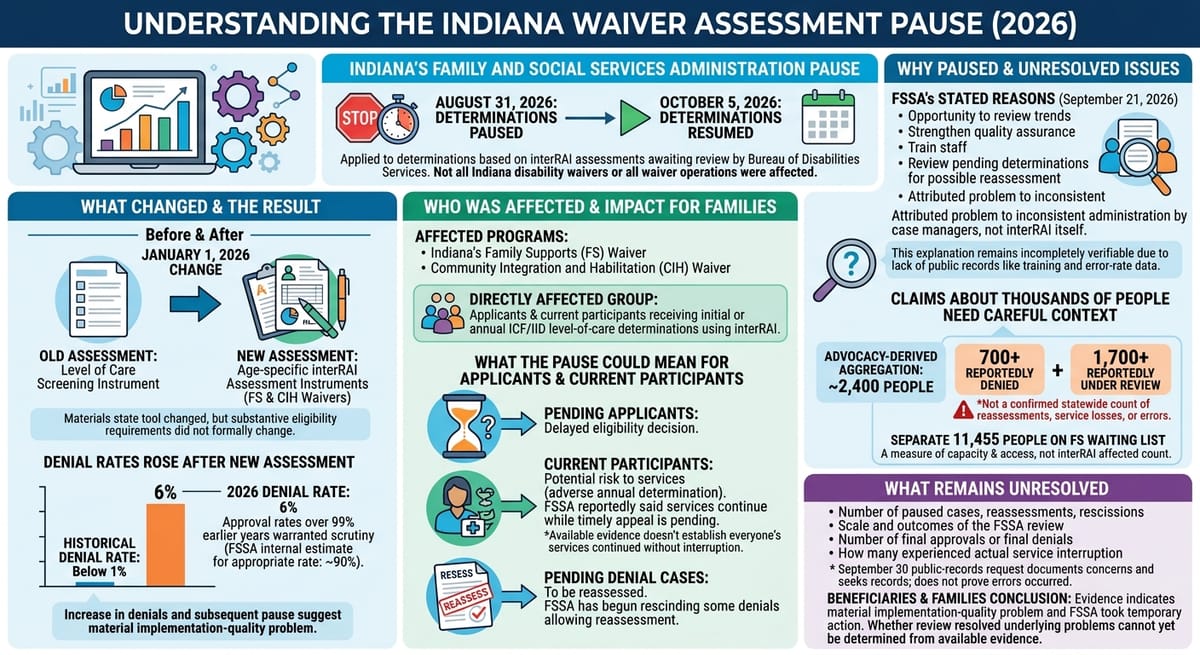
Indiana’s Family and Social Services Administration paused certain level-of-care determinations for two disability waivers on August 31, 2026, and resumed them October 5.
The pause applied to determinations based on interRAI assessments awaiting review by the Bureau of Disabilities Services. It did not apply to every Indiana disability-related waiver or all waiver operations.
For families, the central issue is that the assessment process changed early in 2026, denial rates later rose, and FSSA temporarily stopped some decisions while it reviewed how assessments were being administered. Publicly available evidence does not yet show how many determinations were paused, reassessed, rescinded, affirmed, reversed, or remain pending.
Which waivers and people were affected
The affected programs were Indiana’s Family Supports (FS) waiver and Community Integration and Habilitation (CIH) waiver.
These waivers serve people with intellectual and developmental disabilities who require an institutional level of care if home- and community-based services are not available. The directly affected group included applicants and current waiver participants receiving an initial or annual ICF/IID level-of-care determination using interRAI.
What changed in January 2026
Beginning January 1, 2026, FSSA replaced the former Level of Care Screening Instrument with age-specific interRAI assessment instruments for FS and CIH ICF/IID level-of-care assessments.
FSSA’s materials say the assessment instrument changed, but the substantive eligibility requirements did not. The Family Supports waiver framework also requires approved interRAI instruments to be considered alongside collateral records, and FSSA retains final authority over level-of-care approvals and denials.
That distinction matters: available evidence supports that Indiana changed the assessment process, not that it formally changed the underlying eligibility criteria.
Denials rose after the new assessment began
Independent reporting, based on FSSA information, described a 6% denial rate in 2026 after interRAI implementation, compared with a historical denial rate below 1%.
FSSA said approval rates above 99% in earlier years warranted scrutiny. The agency cited an internal estimate suggesting an approval rate closer to 90% might be appropriate. That estimate was FSSA’s position, not an independently validated benchmark.
The increase in denials and the later pause point to a material implementation-quality problem. But the available evidence does not establish the full cause. It does not show whether the issue was limited to inconsistent training, involved decision-making practices, involved the use of collateral information, or reflected a combination of factors.
Why FSSA paused determinations
At the September 21, 2026 Medicaid Advisory Committee meeting, FSSA described the pause as an opportunity to review trends, strengthen quality assurance, train staff, and review pending determinations for possible reassessment.
FSSA attributed the problem to inconsistent administration of the assessment process by case managers, rather than a defect in interRAI itself.
That explanation remains incompletely verifiable. Training records, fidelity-review records, validation materials, error-rate information, and detailed outcome data were not located in the accepted research.
The agency resumed the affected determinations October 5.
What the pause could mean for applicants and current participants
For pending applicants, the pause could have delayed an eligibility decision.
For current waiver participants receiving an adverse annual determination, there was potential risk to services. FSSA reportedly said services continue while a timely appeal is pending. However, the available evidence does not establish that every participant’s services continued, that no one experienced an interruption, or how any interruption may have affected individuals.
Reporting also indicates that pending denial cases would be reassessed. FSSA had begun rescinding some denials in appealed cases or cases where concerns had been raised, allowing reassessment. That does not establish that all denials were rescinded, appealed, reassessed, reversed, or affirmed.
Claims about thousands of people need careful context
An advocacy and lawmaker claim combined more than 700 people reportedly denied with more than 1,700 reportedly under review, producing a figure of roughly 2,400 or “nearly 2,500” potentially affected people.
That is an unverified advocacy-derived aggregation, not a confirmed statewide count of reassessments, service losses, erroneous denials, or final ineligibility findings. It should not be read as proof that nearly 2,500 people were reassessed or lost services.
No primary FSSA dataset located through October 10, 2026 established how many determinations were paused, reassessed, rescinded, affirmed, reversed, or remained pending. The evidence also does not establish how many affected people were applicants versus current participants, or how many experienced an actual service interruption.
A separate September 2026 count of 11,455 people on the Family Supports waiting list is a measure of capacity and access. It is not a count of interRAI denials, reassessments, or people affected by the pause.
What remains unresolved
The documented facts are limited but important: FSSA adopted interRAI for FS and CIH level-of-care assessments in January, denials rose, the agency paused certain determinations August 31, and it resumed them October 5 after describing a need for review, quality assurance, and training.
Still unknown are the scale and outcomes of the review. Public records located for this reporting do not establish the number of paused cases, reassessments, rescissions, final approvals, final denials, or pending cases.
On September 30, The Arc of Indiana submitted a public-records request seeking information on methodology, validation, training, quality assurance, errors, appeals, and outcomes. The request documents concerns and seeks records; it does not itself prove that errors occurred.
For beneficiaries and families, the most accurate conclusion is that the evidence indicates a material implementation-quality problem in this assessment process and that FSSA took a temporary action affecting specified FS and CIH level-of-care determinations. Whether the review resolved the underlying problems, and what happened to the affected cases, cannot yet be determined from the available public evidence.