Indiana’s October 2026 Medicaid Change: What It Means for Some Title IV-E Children
Beginning October 1, 2026, Indiana’s policy limited full Medicaid coverage for certain immigration categories, with Emergency Services Only Medicaid and limited Refugee Medical Assistance among the possible alternatives.

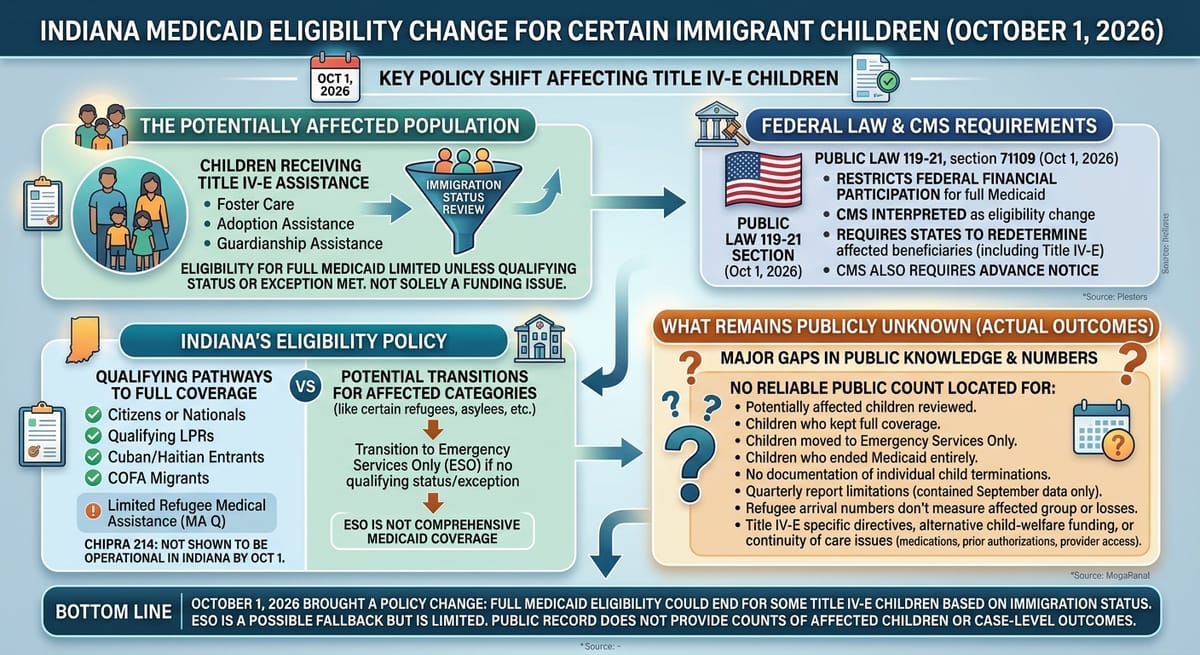
The key change
Beginning October 1, 2026, Indiana implemented a federal immigration-status restriction as a change in eligibility for full Medicaid coverage. For potentially affected children receiving Title IV-E foster-care, adoption-assistance, or guardianship-assistance benefits, the available records support an important distinction: the change was not treated simply as a federal funding-accounting issue.
Indiana’s published policy indicates that some people in affected immigration categories could no longer qualify for full Medicaid unless they had a qualifying status or met an exception. Depending on the person’s circumstances, possible outcomes included retaining full coverage through an exception, receiving limited Refugee Medical Assistance, or moving to Emergency Services Only Medicaid (ESO). ESO is not comprehensive Medicaid coverage.
What is not publicly established is equally important. No reliable public count was located for Indiana Title IV-E children who were reviewed, kept full coverage, moved to ESO, or ended Medicaid coverage entirely. The reviewed record also does not document individual Title IV-E child terminations.
What federal law and CMS required
Public Law 119-21, section 71109, became applicable October 1, 2026. It restricted federal financial participation for full Medicaid and CHIP benefits based on immigration status, subject to specified exceptions.
CMS interpreted the provision as potentially changing Medicaid and CHIP eligibility, rather than only changing whether the federal government would help pay for coverage. CMS also recognized that a state could separately choose to offer state-only coverage.
CMS instructed states to redetermine potentially affected beneficiaries. Its implementation tool specifically included children receiving Title IV-E foster-care, adoption-assistance, or guardianship-assistance benefits in the group requiring review. CMS also required advance adverse-action notice when benefits were reduced or terminated.
Title IV-E assistance alone did not decide whether a child remained eligible for full Medicaid after October 1. The relevant question was whether the child had an immigration status that remained eligible for full coverage or qualified through another federal exception.
Indiana’s policy: a full-coverage eligibility change
Indiana’s September 1, 2026 provider bulletin said the change affected eligibility determinations for all Medicaid programs except Emergency Services Only Medicaid.
Under Indiana’s published policy, citizens or nationals, qualifying lawful permanent residents, Cuban/Haitian entrants, and COFA migrants could qualify for full coverage after October 1, subject to other program requirements.
Indiana’s eligibility materials direct affected refugees, humanitarian parolees, asylees, and trafficking survivors to transition to ESO if they do not adjust to a qualifying status or meet an exemption. That means Indiana implemented the change as a loss of full-scope Medicaid eligibility for affected categories, rather than solely as a loss of federal matching funds.
The potentially affected Title IV-E population was narrower than all children receiving Title IV-E assistance. It consisted of children who lacked a status that remained eligible for full coverage and did not qualify through another federal exception.
What Emergency Services Only Medicaid means
Emergency Services Only Medicaid is a possible transition identified in Indiana policy for some affected people. It is not comprehensive Medicaid coverage.
That distinction matters because a move from full Medicaid to ESO should not be described as retaining the same Medicaid benefits. At the same time, the policy does not establish that every potentially affected child lost all Medicaid eligibility: ESO could be available, and some people could qualify through an eligible status or exception.
Exceptions and limited Refugee Medical Assistance
Several pathways could preserve full coverage for some people.
Refugees, asylees, and trafficking survivors who adjust to lawful permanent resident status may retain full coverage without the ordinary five-year waiting period. Other federal exceptions may also apply depending on the person’s circumstances.
Indiana also provides Refugee Medical Assistance for qualifying refugees. Under MA Q, qualifying refugees may receive coverage equivalent to full Medicaid for the applicable federally limited period. This is a limited pathway for people who qualify; it does not establish that all affected Title IV-E children retained ordinary comprehensive Medicaid.
CHIPRA 214 was not shown to be operating in Indiana by October 1
CMS’s CHIPRA 214 state list, updated April 2, 2026, did not list Indiana as covering lawfully residing children under that option. A 2023 Indiana statute appears to authorize coverage for lawfully residing children under age 21 and pregnant people without a waiting period. But the accepted record indicates that Indiana had not operationally implemented CHIPRA 214 by October 1, 2026.
That does not establish that Indiana never implemented the option. It means operational implementation had not been established as of the October 1 change, and the accepted evidence did not identify a later approval.
No published state-only comprehensive replacement was identified
A federal restriction on financial participation does not by itself prevent a state from choosing to finance separate comprehensive coverage with state funds. CMS recognized that states could make that choice.
But Indiana’s published materials reviewed for this article do not identify a state-only comprehensive coverage substitute for the affected categories. They instead identify ESO as the transition option for affected refugees, humanitarian parolees, asylees, and trafficking survivors who do not meet an exception or adjust to a qualifying status.
The reviewed record also did not establish whether Indiana provided alternative child-welfare-funded coverage for affected children.
What remains unknown about actual outcomes
The available materials describe federal instructions and Indiana policy, but they do not establish what happened in individual Title IV-E cases after October 1.
No reliable public count was located of Indiana Title IV-E children who were:
- identified for redetermination;
- retained through citizenship, nationality, lawful permanent resident status, Cuban/Haitian entrant status, COFA status, Refugee Medical Assistance, or another exception;
- moved to Emergency Services Only Medicaid; or
- terminated from Medicaid entirely.
The reviewed October 27, 2026 Indiana quarterly report contained September data only. As a result, it did not establish post-October, category-specific termination data.
Indiana reported 162 refugee arrivals from November 2025 through September 2026 and 62 Refugee Medical Assistance recipients in September 2026. Those figures do not measure affected children, Medicaid members, Title IV-E recipients, or coverage losses.
The reviewed record also did not establish whether Indiana issued Title IV-E-specific child-welfare directives or member notices, whether it provided alternative child-welfare-funded coverage, or whether transitions preserved medication access, prior authorizations, or provider access.
Bottom line
For potentially affected Indiana children receiving Title IV-E foster-care, adoption-assistance, or guardianship-assistance benefits, October 1, 2026 brought a policy change that could end eligibility for comprehensive Medicaid unless the child had a qualifying immigration status or another exception. Indiana’s published materials identify ESO as a possible fallback for affected categories, while limited Refugee Medical Assistance and qualifying-status exceptions may preserve full coverage for some people.
The public record reviewed does not support a count of children who actually lost comprehensive coverage, moved to ESO, or left Medicaid altogether. It also does not document case-level outcomes for individual Indiana Title IV-E children.