Indiana HIP Work Requirements: What Starts in 2027 and Who May Be Exempt
Indiana’s HIP work requirements were not enforced in 2026. FSSA says enforcement begins January 1, 2027, for certain HIP adults, with exemptions, documentation opportunities, notices, and appeal rights.

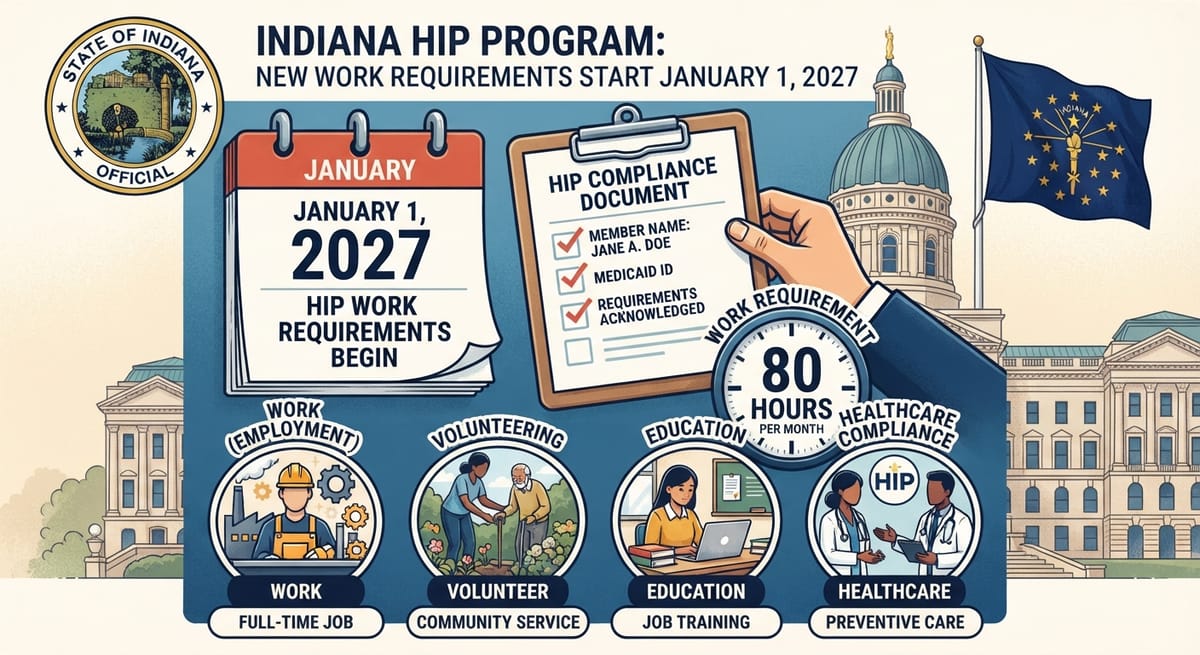
Enforcement begins January 1, 2027
Indiana’s HIP work requirements were not being enforced in 2026. The Indiana Family and Social Services Administration (FSSA) says enforcement begins January 1, 2027.
The work-requirement provisions took effect under state law on July 1, 2026. During 2026, the state conducted outreach, sent notices, developed portal tools, and prepared for implementation.
The requirements apply statewide to HIP, Indiana’s Medicaid expansion coverage. HIP covers adults with income up to 138% of the federal poverty level.
Who is covered by the requirement
The requirements generally apply to HIP adults ages 19 through 64 who are not excluded or exempt.
They do not apply to children, traditional Medicaid populations outside HIP, or people who meet an applicable statutory exclusion or medical-frailty exemption.
FSSA says the January 1, 2027 enforcement date applies to new applicants and to existing HIP members at applicable renewals or redeterminations. Its notice says members with renewals on or after April 1, 2027, must establish compliance or an exemption for the preceding three months.
Ways to meet the requirement
The general standard is 80 hours per month of one or more approved activities, including:
- Work
- Volunteering or community service
- Participation in an approved work program
- School
- Apprenticeship
FSSA also identifies half-time school or apprenticeship participation and monthly income of at least $580 as alternative compliance pathways.
Employment is not the only way to meet the requirement, and some people may be excluded or exempt.
Exemptions and exclusions
FSSA and state law identify several exemption or exclusion pathways. They include:
- Medical frailty
- Pregnancy or postpartum status
- Qualifying caregiving responsibilities
- Incarceration or recent release
- Half-time education
- Compliance with SNAP or TANF work rules
- Tribal status
- Former foster youth under age 26
- Total VA disability
Whether a person qualifies depends on the applicable pathway and the state’s review process.
How verification and notices are expected to work
FSSA says it plans quarterly verification. The agency says it will first use existing data to determine whether a HIP member is compliant or exempt.
If available data do not verify compliance or an exemption, FSSA’s member notice describes a 35-day period for the member to provide documentation. A separate notice must come before a termination, and members have appeal rights.
An initial inability to verify a member’s status through administrative data is not itself a coverage termination. It also does not establish that the person is ineligible for an exemption or unable to meet a requirement.
A person who does not demonstrate compliance or an approved exemption after the required process can lose HIP coverage. FSSA says someone whose HIP coverage ends for this reason may reapply immediately and is not subject to a lockout.
FSSA also states that this type of coverage loss does not create a Marketplace special-enrollment period and bars premium tax credits during the loss period.
The accepted record does not establish every unanswered question about cure procedures or whether compliance or an exemption can be established retroactively before termination.
What the more-than-58,000 figure means — and does not mean
FSSA reported outreach to more than 500,000 HIP members. On October 5, 2026, it estimated that more than 58,000 HIP members might not then be identifiable as compliant with or exempt from the future requirements.
That figure is an administrative screening estimate, not a count of confirmed violations, completed disenrollments, or people certain to lose coverage.
FSSA has not published the methodology, underlying dataset, denominator, or member-level status breakdown behind the estimate. The group may include people who qualify for an exemption or satisfy a requirement but whose status had not yet been verified through available administrative data.
No evidence in the accepted record establishes HIP terminations under the new 2026–2027 framework as of October 31, 2026.
Indiana’s earlier community-engagement policy was never fully implemented and produced no disenrollments for noncompliance.
HIV and medical-frailty review
HIV is not named as a discrete categorical exemption in Indiana’s public exemption materials. A search of FSSA’s published Tier 1 diagnosis list found no HIV, human immunodeficiency, or B20 entry. This supports the limited conclusion that HIV is not a published diagnosis-only Tier 1 automatic pathway.
That absence does not mean a person with HIV cannot receive a medical-frailty exemption.
FSSA describes three medical-frailty review pathways. Tier 2 uses claims, treatment, or service evidence, while Tier 3 allows individualized clinical review. FSSA says conditions not included in Tier 1 may qualify through Tier 2 or Tier 3.
The accepted record does not establish the specific evidence or clinical criteria FSSA will apply to HIV-related medical-frailty requests. Tier 2 or Tier 3 review also does not guarantee an exemption for every person with HIV.
A pending waiver and projected modeling
Indiana’s pending HIP 3.0 waiver application assumes that roughly 20% of the non-medically-frail expansion group will disenroll because of noncompliance, with a partial 10% effect in the first demonstration year.
That is prospective financial modeling, not observed data, a finalized outcome, or a verified disenrollment count. CMS approval of the pending HIP 3.0 waiver remained unresolved as of the CMS listing reviewed October 31, 2026.
What remains unknown
Important unanswered questions include how FSSA calculated the more-than-58,000 screening estimate, how many people in that group may already qualify for an exemption or meet a compliance pathway, and what evidence will support HIV-related medical-frailty requests.
For now, the central point is that enforcement is scheduled to begin in 2027—not 2026—and that HIP members may have compliance, exclusion, exemption, documentation, notice, appeal, and reapplication options depending on their circumstances.