Indiana HIP work requirement is set to begin Jan. 1, 2027: What is known
Indiana says its HIP work requirement will begin Jan. 1, 2027. Here is who may be affected, how the 80-hour standard works, what exemptions are recognized, and what details have not yet been publicly established.


The key date
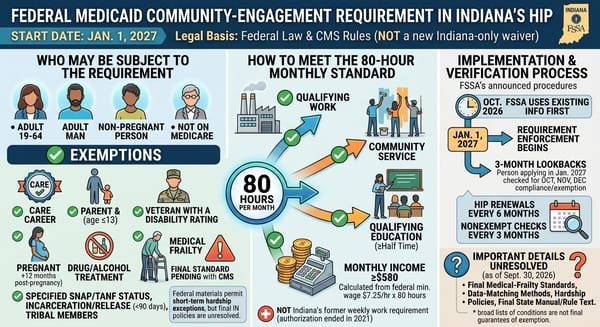
Indiana says its HIP work requirement will begin Jan. 1, 2027, implementing a federal Medicaid community-engagement requirement under Public Law 119-21 and CMS's June 1, 2026 interim final rule.
The policy is not limited to employment. For people who are subject to it, the standard is generally 80 hours per month of qualifying activity or an applicable exemption.
Indiana says new applicants and redeterminations initiated on or after Jan. 1, 2027 will be subject to the requirement. Existing HIP members will be checked according to their renewal timing, not all at once on Jan. 1.
Who may be affected
Indiana identifies the likely affected population as HIP adult-group applicants and members who:
- Are ages 19 through 64;
- Are not pregnant or postpartum; and
- Are not enrolled in or entitled to Medicare.
An exclusion or exception can still apply. Federal policy generally applies to nonpregnant adults in this age range who are in the Medicaid adult group or certain Section 1115 populations and are not enrolled in or entitled to Medicare, unless an exclusion or exception applies.
What can meet the 80-hour standard
Indiana says qualifying activity can include:
- Work;
- Volunteering;
- Work-program participation;
- Apprenticeship; or
- Qualifying education.
Half-time education can also satisfy the requirement. Earnings equal to at least 80 times the federal minimum wage may qualify as well.
The three-month lookback: what it does and does not mean
For a person applying in January 2027, Indiana says compliance or an exemption must be established for October, November, and December 2026.
That October-through-December lookback is clearly identified for January 2027 applicants. It is not an Oct. 1, 2026 statewide enforcement date, and it does not mean every current HIP member must start submitting proof in October 2026.
For existing members, Indiana's sample notice describes a renewal-based process. It says renewals on or after April 1, 2027 will require proof of compliance or an exemption for each of the preceding three months.
Verification, notices, and ways to report information
Federal policy requires states to first try to verify compliance or an exclusion using available information. This is commonly called ex parte verification: using data already available before asking the member to provide information.
If compliance or an exclusion cannot be verified, the federal rule requires at least 30 calendar days to respond. Indiana's sample notice says the Family and Social Services Administration, or FSSA, will first use information it already has. If it cannot verify compliance or an exemption, the notice says members will have 35 days to submit information.
Indiana identifies these reporting options:
- Benefits Portal;
- Mail;
- Telephone; and
- In-person reporting.
The sample notice also says a separate adverse-action notice will explain the reason and appeal process before coverage ends.
Exemptions Indiana recognizes
Indiana publicly recognizes medical frailty, substance-use disorder, serious mental-health conditions, disability, and serious or complex medical conditions as possible exemption categories.
Other exemptions identified by Indiana include:
- Former foster youth under age 26;
- Federally recognized Tribal members;
- Certain caregivers;
- Veterans with total disability ratings;
- Pregnancy or postpartum status;
- Certain incarceration or reentry circumstances;
- Qualifying SNAP or TANF participation; and
- Participation in drug or alcohol treatment.
These categories matter, but a listed diagnosis or circumstance does not necessarily establish an exemption in every individual case.
Medical frailty: recognized policy, individualized decisions
Federal policy requires that a physical, mental, or behavioral-health condition significantly impair a person's ability to meet the community-engagement requirement for the medical-frailty exclusion to apply.
Indiana says medical frailty and several health-related categories may qualify. Its existing medically-frail materials list conditions including HIV/AIDS and mental-health conditions such as major depression, schizophrenia, bipolar disorder, and PTSD. But Indiana also says a listed diagnosis alone does not guarantee medically-frail status because severity and functional impact may be evaluated.
For example:
- HIV/AIDS: Indiana lists HIV/AIDS as a condition that may support medical-frailty status. CMS requires an individualized assessment of acuity and functional impact; HIV does not automatically exempt every person living with HIV.
- Mental-health conditions: Indiana identifies serious mental-health conditions as potentially exempting. CMS requires a disabling mental disorder that significantly impairs a person's ability to comply.
- Substance-use disorder: Indiana includes substance-use disorder in its exemption description. Under CMS's current rule, people in stable recovery for five or more years are excluded from the substance-use-disorder definition unless another qualifying category applies.
- Disability: Blindness, disability, and certain physical, intellectual, or developmental disabilities may support a medical-frailty exclusion when the applicable impairment standard is met.
CMS requires states to maintain an auditable, regularly revised medical-condition list and a reasonable process for considering conditions not on that list.
Homelessness and hardship questions
Homelessness is not a standalone federal medical-frailty exemption. A person experiencing homelessness may qualify through another exclusion, such as a co-occurring substance-use disorder, disabling mental disorder, disability, or serious or complex medical condition.
Indiana's earlier Gateway to Work materials included a homelessness exemption. That prior waiver-era policy does not establish the exemption rules for the 2027 federal requirement.
The reviewed materials did not establish whether Indiana will adopt optional federal short-term hardship exceptions. That includes whether Indiana will use any optional hardship pathway relevant to homelessness or other circumstances.
What remains unpublished or unverified
Indiana has announced its start date, broad exemption categories, reporting channels, and a retrospective verification framework. But important operational details were not established in the reviewed materials.
Those materials did not establish that Indiana has publicly posted:
- Its final 2027 medical-frailty condition list or code sets;
- Functional-impairment decision standards;
- Manual-review procedures;
- Documentation rules for difficult medical-frailty cases;
- Whether optional federal short-term hardship exceptions will be adopted;
- Work-requirement-specific appeal forms, deadlines, continuation-of-benefits rules, or detailed procedures; or
- A completed implementation calendar by renewal cohort.
A staffing plan, testing results, and metrics for failed data matches or notices also were not located in the reviewed materials. That does not establish that such procedures or materials do not exist; it means they were not established by the materials reviewed.
Town-hall materials specifically addressing finalized work-requirement operations were not located. The identified HIP 3.0 public-hearing materials do not establish a finalized work-requirement operations plan.
CMS has acknowledged that implementation requires substantial state policy, systems, and operational changes and anticipates additional guidance needs.
What is still unknown about scale
No authoritative Indiana estimate was located for how many HIP members will be subject to the requirement, exempted through data matching, required to submit documentation, or at risk of disenrollment.