Indiana says federal HIP community-engagement requirement will begin Jan. 1, 2027
Beginning Jan. 1, 2027, Indiana says some HIP applicants and members will face a federal community-engagement requirement. FSSA’s announced process includes exemptions, data-first verification, a chance to respond and review for other Medicaid eligibility before HIP coverage ends.

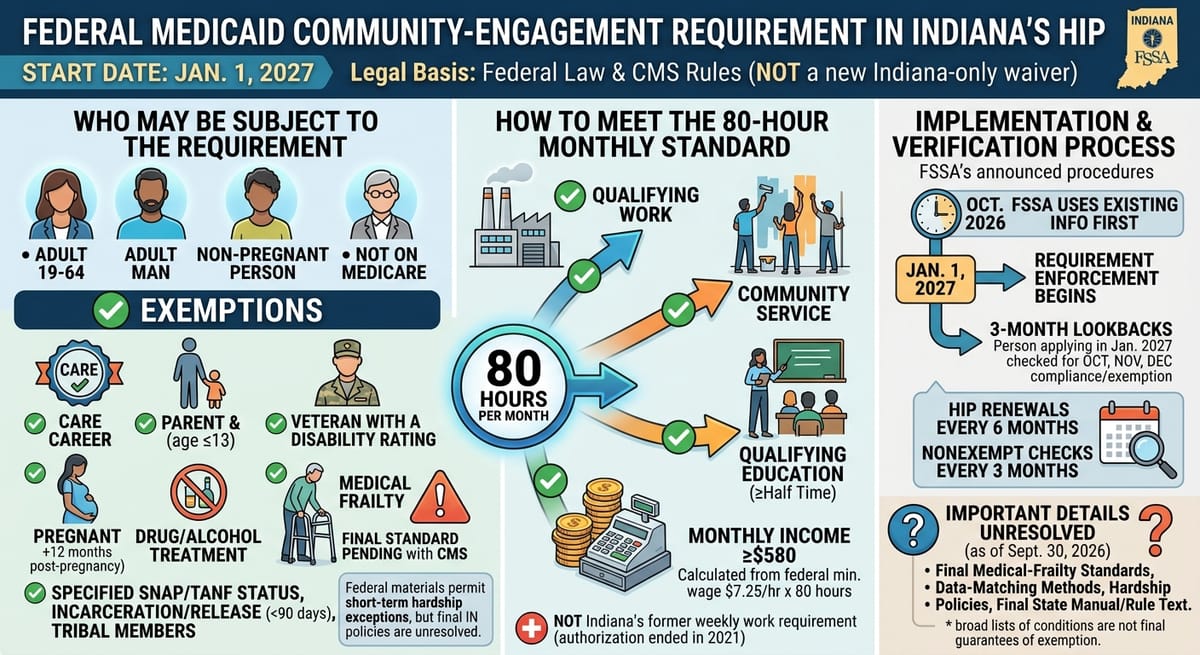
Indiana says it will begin enforcing a federal Medicaid community-engagement requirement through the Healthy Indiana Plan, or HIP, on Jan. 1, 2027.
This is not a newly approved Indiana-only waiver requirement. The requirement stems from federal law and CMS implementation rules. CMS issued an interim final rule on June 1, 2026, generally requiring states to implement the condition by Jan. 1, 2027.
Indiana Family and Social Services Administration, or FSSA, has announced how it expects to operate the requirement for affected HIP applicants and members. The announcement includes an 80-hour monthly standard, three-month reviews, HIP renewals every six months and quarterly compliance checks for nonexempt members.
Important details remained unresolved as of Sept. 30, 2026, including final medical-frailty standards, documentation standards, data-matching methods, optional hardship policies and final state manual or administrative-rule text.
Who may be subject to the requirement
The requirement generally applies to HIP adult-group applicants and members who are:
- Ages 19 through 64;
- Not pregnant; and
- Not enrolled in or entitled to Medicare.
Not every HIP member—and not every Indiana Medicaid beneficiary—is subject to the requirement. Available exclusions and exemptions are important.
FSSA-listed exclusions or exemptions include:
- Former foster youth under age 26;
- Members of federally recognized Tribes;
- A parent or caregiver of a child age 13 or younger;
- A caregiver of a person with a disability;
- A veteran with a 100 percent disability rating;
- Pregnancy and up to 12 months after pregnancy ends;
- Incarceration or release within the prior 90 days;
- Specified SNAP or TANF work-rule status;
- Participation in drug or alcohol treatment; and
- Medical frailty or special medical needs.
FSSA was still working with CMS on the medical-frailty exclusion standard as of Sept. 30, 2026. That means broad lists of health conditions should not be treated as a final, diagnosis-based guarantee of exemption.
Federal materials also permit certain short-term hardship exceptions. But no final Indiana public document located through Sept. 30, 2026 established which optional hardship exceptions Indiana will use.
The 80-hour standard and other ways to meet it
For people who are subject to the condition and not exempt, the standard generally can be met by:
- Completing 80 hours a month of qualifying work, community service or work-program activities;
- Combining qualifying activities for a total of 80 hours a month;
- Attending qualifying education at least half time; or
- Having monthly income of at least 80 times the federal minimum wage.
The accepted record identifies that income amount as $580 per month using a federal minimum wage of $7.25 per hour.
The announced standard is 80 hours per month. It should not be confused with Indiana’s former HIP work-requirement authorization, which used a different age range and a 20-hours-per-week design. That older authorization was withdrawn or ended in 2021 and is not the legal basis for the 2027 policy.
Three-month lookbacks may start before January 2027
FSSA has announced a three-month lookback process.
Applicants would be reviewed for the three months before the month of application. Current members would be reviewed for the three months before a renewal or quarterly review.
That means a person applying in January 2027 may need to establish compliance or an exemption for October, November and December 2026.
According to FSSA’s sample notice, renewals on or after April 1, 2027, would first require proof of compliance or exemption for the preceding three months.
Renewals every six months and checks every three months
Indiana announced that HIP renewals will occur every six months. It also announced that nonexempt members will undergo community-engagement compliance checks every three months.
These are announced operational details, not a guarantee of exactly how every system or notice will work once implementation begins.
FSSA says it will check existing information first
FSSA says it will first use information it already has to determine whether someone meets the requirement or qualifies for an exemption. People are not described as automatically losing HIP simply because they did not independently report hours.
If FSSA cannot verify compliance or an exemption, its sample notice says the person would have 35 days to provide information. The announced ways to respond include the portal, mail, telephone or an in-person visit.
CMS requires states to provide at least 30 calendar days to respond. For an enrolled person, coverage must continue during that response period. Before terminating HIP coverage, the state also must assess whether the person qualifies for another Medicaid eligibility category, provide written adverse-action notice and provide fair-hearing rights.
A nonexempt person may lose HIP if FSSA cannot establish compliance after notice and an opportunity to respond. That is different from an automatic termination for failing to self-report hours.
What happens if HIP coverage ends for noncompliance
FSSA says a person who loses HIP for failure to satisfy the requirement may reapply immediately. FSSA says there is no lockout period.
Before ending HIP coverage, FSSA must assess whether the person may qualify for another Medicaid coverage category.
There are also important Marketplace consequences. Under federal law, an otherwise-eligible person who fails the requirement is treated as eligible for Medicaid minimum essential coverage during that period. That bars Marketplace advance premium tax credits or premium tax credits for that period.
FSSA also says that losing HIP for failure to satisfy the requirement does not create a Marketplace special-enrollment period.
What remained unresolved as of Sept. 30, 2026
Indiana had released provider guidance, member notices, FAQs, a portal or pre-screening tool, sample notices and partner-toolkit guidance. FSSA began initial member-notice outreach in July 2026 and released implementation materials and toolkit guidance that month.
But key implementation matters had not been established in final public materials as of Sept. 30, 2026. They included:
- Detailed data sources and matching logic;
- Documentation standards for activities;
- Definitions for some activities;
- Final medical-frailty standards;
- Which optional hardship exceptions Indiana will implement;
- Final state eligibility-manual text;
- Final administrative rules;
- Actual system behavior after implementation; and
- Termination volumes.
No final Indiana administrative rule, revised Medicaid eligibility-manual provision or Indiana-specific CMS approval for the 2027 requirement was located through that date.
No authoritative Indiana projection was identified for how many people would be subject to the requirement, qualify for exemptions, be denied, lose coverage or have procedural closures.
Indiana’s HIP 3.0 waiver application remained a draft and public-notice matter as of that date. It was not the legal basis for the federal community-engagement requirement.
Where the announced information came from
The federal framework is described in CMS’s Medicaid Community Engagement Requirement fact sheet. Indiana’s announced HIP process appears in FSSA’s HIP work-requirements information, partner toolkit and sample member notice.
People affected by the announced requirement may want to watch for FSSA notices and review whether an exclusion or exemption may apply. Because several operational details remained unresolved as of Sept. 30, 2026, later state guidance may be needed to explain documentation, hardship requests and medical-frailty determinations.