Indiana’s Planned Medical-Frailty Reviews for HIP Work Requirements: What Is Known Before 2027

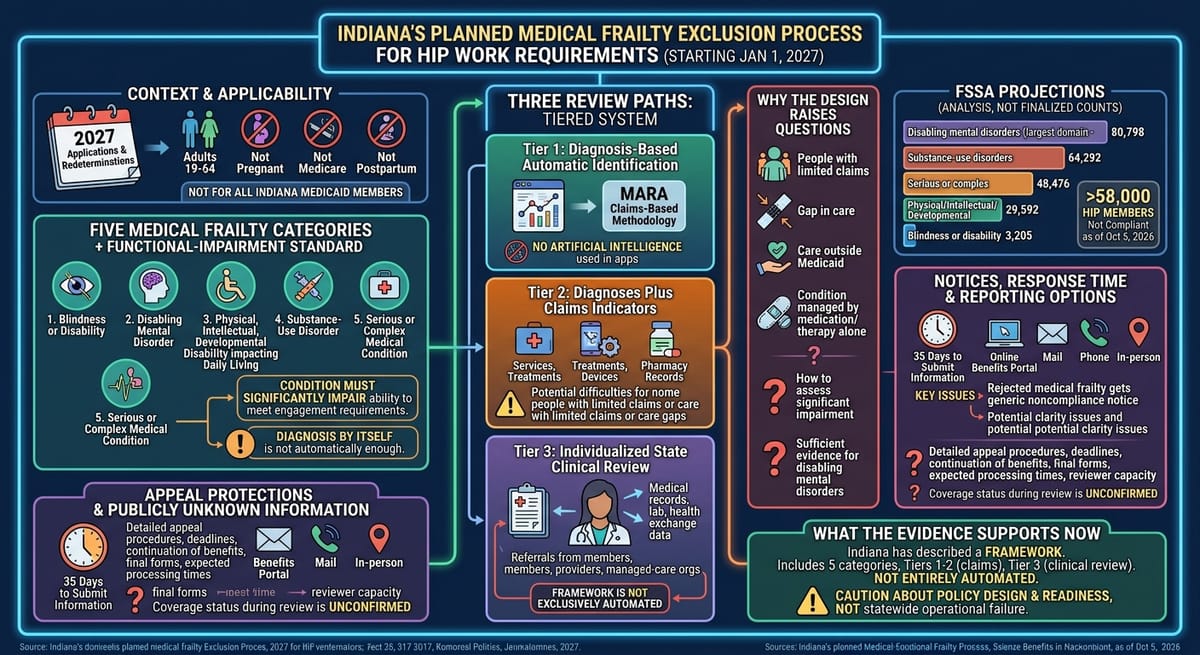
A planned exclusion process begins with 2027 applications and renewals
Beginning January 1, 2027, Indiana’s HIP work requirements apply to new applications and redeterminations initiated on or after that date. The directly affected population is generally HIP, or Medicaid expansion, adults ages 19 through 64 who are not pregnant, are not within the postpartum exclusion period, are not enrolled in or eligible for Medicare, and do not qualify for another statutory exclusion.
This is not a requirement for all Indiana Medicaid members or every adult in that age range.
Indiana’s Family and Social Services Administration, or FSSA, described a planned medical-frailty process intended to exclude qualifying HIP members from federal community-engagement requirements. The state presented the framework on October 27, 2026.
The available record describes a policy design before implementation. It does not establish that Indiana has wrongfully terminated coverage, denied exclusions, delayed decisions, or experienced statewide processing failures under the planned 2027 process.
Five categories, plus a functional-impairment standard
Indiana identifies five medical-frailty categories:
- Blindness or disability.
- A disabling mental disorder.
- A physical, intellectual, or developmental disability that impairs activities of daily living.
- A substance-use disorder.
- A serious or complex medical condition.
Being in one of these categories alone is not enough under Indiana’s framework. The condition must significantly impair the person’s ability to meet community-engagement requirements.
That functional-impairment standard is central to the design. It means a diagnosis by itself does not automatically establish a medical-frailty exclusion.
Indiana specifically states that disabling mental disorders do not qualify through diagnosis alone. Under the planned process, supporting claims evidence may be needed in Tier 2, or the case may go to individualized clinical review in Tier 3.
Three review paths: automated screening and individualized review
FSSA describes three tiers for identifying qualifying members.
Tier 1: Diagnosis-based automatic identification
Tier 1 uses MARA for diagnosis-based automatic identification. FSSA describes MARA as a claims-based methodology and says artificial intelligence is not used to process applications.
Tier 2: Diagnoses plus claims indicators
Tier 2 uses diagnoses together with claims indicators. Those indicators can include services, treatments, supports, devices, procedures, or pharmacy records.
Tier 3: Individualized state clinical review
Tier 3 provides an individualized clinical review by the state. Referrals may come from members, providers, or managed-care organizations. Review may include medical records, treatment notes, medication lists, laboratory results, and health-information-exchange data.
This means the framework is not exclusively automated. It includes a path for individualized clinical review when automatic or claims-based identification does not resolve the question.
Why the design raises questions for some members
The public materials support concern about policy design and implementation readiness, not a conclusion that the system has failed in practice.
Because the framework relies in part on claims and evidence of functional impairment, it may be harder for some people to be identified through automated or claims-based screening. That includes people whose disabling conditions generate limited claims, people with gaps in care, people receiving care outside Medicaid billing, and people whose conditions are managed through medication, therapy, or intermittent treatment.
The evidence does not establish that Indiana’s process will reliably identify every eligible person. The concern is particularly important for people with disabling mental disorders and for people whose conditions are controlled through treatment, because it remains unresolved how Indiana will assess significant impairment in those circumstances.
It also remains unresolved what evidence will be sufficient for disabling mental disorders in Tier 2 or Tier 3.
These are not findings that any person will be improperly denied. They are open questions about how a planned system will work when it begins.
What FSSA’s projections show—and do not show
FSSA projected 139,301 medically frail expansion members in its analysis. That is an analysis projection, not a finalized count of 2027 exclusions.
The projected clinical domains overlap and must not be added together as separate people. Within those overlapping projections, FSSA listed:
- 80,798 members with disabling mental disorders;
- 64,292 with substance-use disorders;
- 48,476 with serious or complex conditions;
- 29,592 with physical, intellectual, or developmental disabilities affecting activities of daily living; and
- 3,205 with blindness or disability.
Disabling mental disorders were the largest projected frailty domain in FSSA’s analysis.
Separately, FSSA estimated that more than 58,000 HIP members were not shown as compliant with pending work requirements as of October 5, 2026. That estimate is not a finding of final ineligibility or coverage loss. Members may later establish compliance or qualify for an exemption.
Notices, response time, and reporting options
CMS requires at least 30 calendar days for a person to demonstrate compliance or an exemption when a state cannot verify either before denial or disenrollment.
Indiana’s sample notice provides 35 days to submit information when existing records do not confirm a qualifying activity or exemption. The sample materials list reporting options through the online Benefits Portal, mail, phone, and in-person reporting.
Indiana says a separate coverage-ending notice will explain appeal rights.
But the state’s public materials also say that a rejected medical-frailty determination will not receive a separate medical-frailty decision notice. Instead, a member without a verified activity or exemption receives a general noncompliance notice.
That approach may make the disputed issue less clear and complicate timely correction. The available evidence does not establish, however, that it will cause improper denials.
Appeal protections and coverage during review remain unclear
The practical adequacy of Indiana’s appeal protections cannot yet be confirmed. Detailed appeal procedures, deadlines, continuation-of-benefits rules, and final adverse-action notices were not publicly located in the accepted research.
It remains unresolved whether coverage continues during a Tier 3 review, during the 35-day response period, or during an appeal.
Other information also was not publicly located, including:
- the full public MARA criteria and methodology;
- exact Tier 2 evidence rules;
- final medical-frailty forms and denial notices;
- expected processing times;
- reviewer capacity, staffing standards, caseload targets, and quality-control procedures; and
- final CMS or state approval materials.
Indiana’s public materials indicate that FSSA was still working with CMS on medical-frailty requirements and that additional guidance would be issued.
How often reviews are planned
Indiana says HIP renewals will occur every six months and compliance checks every three months. The public materials do not disclose how many people are expected to qualify through each tier or how long Tier 3 clinical reviews will take.
For members and families, the practical point is that an exclusion may depend on records already available to the state, information submitted in response to a notice, or an individualized clinical review.
What the evidence supports now
Indiana has described a framework that includes all five medical-frailty categories, claims-based screening in Tiers 1 and 2, and individualized state clinical review in Tier 3. The framework does not treat every diagnosis as automatically qualifying, and it does not rely entirely on automated processing.
The record also supports concern that a claims-based, functional-impairment approach may be difficult for some eligible people to navigate, especially when their disabling condition is not fully visible in claims data.
What remains unknown is whether the state’s final criteria, forms, notices, staffing, review timelines, and appeal procedures will provide workable protections in practice. Because implementation has not begun, the available evidence supports caution about policy design and readiness—not a finding of demonstrated statewide operational failure.