Indiana’s HIP Work Requirement Is Scheduled to Begin January 1, 2027
Indiana says certain Healthy Indiana Plan adults will need to meet a monthly activity, school, apprenticeship, or income standard starting with applications and redeterminations initiated January 1, 2027, unless they qualify for an exemption.

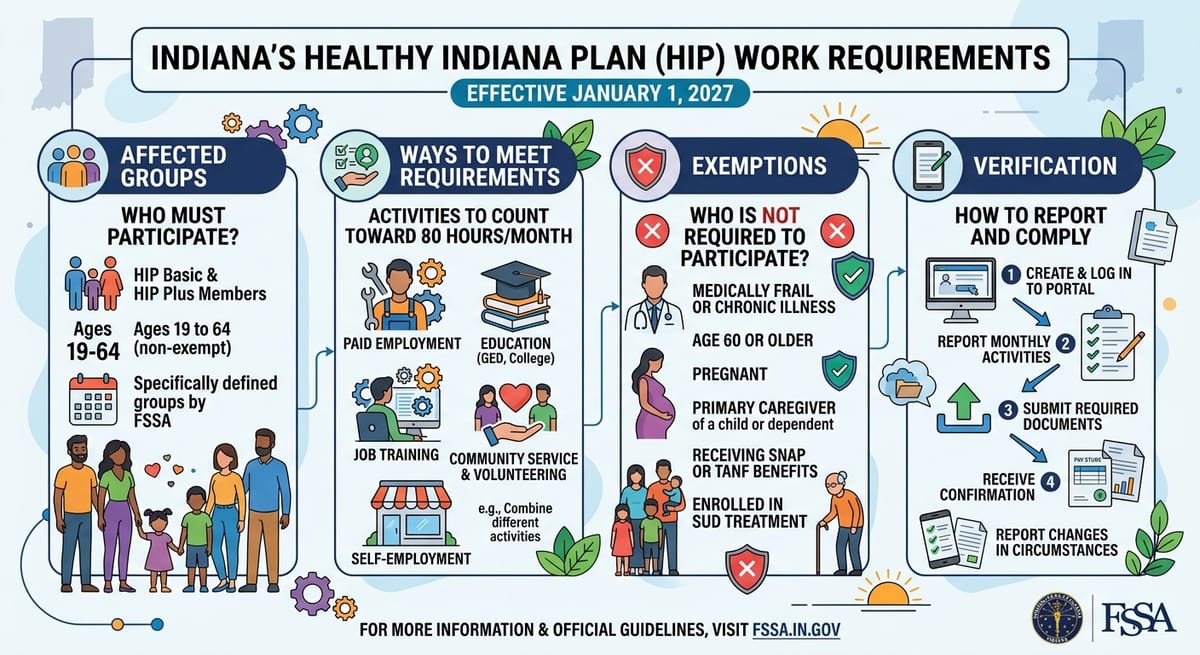
Indiana has finalized and is preparing to implement a Healthy Indiana Plan, or HIP, work requirement scheduled to begin January 1, 2027. The requirement is not currently being enforced.
The policy chiefly implements a nationwide Medicaid community-engagement requirement and a CMS interim final rule issued June 1, 2026. The available record does not show CMS approving a new Indiana-specific work-requirement waiver in 2026.
Indiana says the requirement will apply to new HIP applications and redeterminations initiated on or after January 1, 2027.
Who may be affected
The requirement is directed at HIP adults who are:
- Ages 19 through 64;
- Not pregnant;
- Not enrolled in or eligible for Medicare; and
- Not otherwise exempt.
It does not apply to every Indiana Medicaid beneficiary or every HIP member.
Ways to meet the requirement
Indiana Family and Social Services Administration, or FSSA, says affected applicants and members may meet the requirement in one of these ways:
- Complete 80 hours a month of qualifying activity;
- Attend school or an apprenticeship at least half time; or
- Have qualifying income of at least $580 per month.
CMS says applicable adults must meet an 80-hour monthly community-engagement requirement at enrollment and renewal starting January 1, 2027, unless a state begins earlier.
Exemptions listed by Indiana
FSSA lists exemptions for several groups, including:
- Former foster youth under age 26;
- Members of federally recognized Tribes;
- Parents or caregivers of a child age 13 or younger;
- Caregivers of a person with a disability;
- Veterans with a total disability rating;
- People who are pregnant or within 12 months postpartum;
- People in specified current or recent incarceration circumstances;
- People meeting SNAP or TANF work rules;
- People in substance-use treatment; and
- People who are medically frail or have special medical needs.
Some important details are still unsettled. FSSA says it is working with CMS on medical-frailty exclusion criteria, including how to determine whether a condition significantly impairs a person's ability to comply.
The record also does not resolve which exemptions will be verified automatically, what information Indiana will match before requesting documents, or whether the state will adopt short-term hardship exceptions.
Reporting, verification, and notices
Indiana has issued member notices, guidance, outreach materials, a pre-screening process, portal reporting, and quarterly verification concepts as part of implementation planning.
CMS permits states to conduct compliance checks between renewals. FSSA's template notice describes quarterly checks. If the state cannot verify compliance or an exemption, the template says it may send a request for information and allow 35 days for a response.
CMS materials provide for at least a 30-day response period and an option to reapply after disenrollment.
FSSA's template notice says that renewals on or after April 1, 2027, will require proof of compliance or an exemption for the preceding three months. But renewal timing is not fully clear: general HIP information describes annual renewals, while work-requirement materials describe six-month renewals for affected members. The accepted record does not resolve that difference.
What could happen if information is not established
FSSA's template notice says coverage may be terminated if an affected person does not meet the requirement or establish an exemption. The process described in the available materials includes verification and a response period; it does not establish that missing one month automatically causes immediate termination.
As of October 16, 2026, the new requirement had not been implemented or enforced. No statewide coverage-loss outcome from the policy had been established.
Outreach and agency estimates are not coverage-loss counts
FSSA says statewide beneficiary outreach began in June 2026 and reported outreach to more than 500,000 HIP members. That is an agency-reported outreach figure, not a count of people subject to the requirement, people who are noncompliant, or people expected to lose coverage.
On October 5, 2026, FSSA reported that more than 58,000 HIP members might then be neither compliant nor exempt. This was an agency estimate, not observed or projected disenrollment, and it was not independently audited. The accepted record also does not resolve the methodology behind that estimate.
Federal basis and pending state demonstration
Indiana's pre-2027 HIP Section 1115 demonstration was listed by CMS as pending and scheduled to expire June 30, 2027. That status does not establish that the federal community-engagement requirement cannot be implemented. The scheduled 2027 requirement rests chiefly on the nationwide statutory requirement and CMS rule, rather than evidence of a newly approved Indiana-specific work-requirement waiver.
What remains to be decided
Indiana has a scheduled implementation date and member-facing materials, but several operational questions remain open. These include final medical-frailty criteria, verification methods for exemptions and compliance, possible hardship exceptions, the renewal-cycle discrepancy, and whether a final Indiana administrative rule or state-plan amendment will codify operating procedures.
For program information, see Indiana FSSA's HIP work requirements page and CMS's community-engagement requirement fact sheet.